By Tilden Culver
A squirrel hit my sister’s umbrella. I watched as it slid down and dropped lifeless to the pavement. I could tell she was watching it, too, from the way her eyes lit up.
“Don’t even think about touching it,” I told her. Her hand, a small, fledgling thing, fell lamely back down. “I’ve told you so many times. You don’t know what kind of diseases they carry.”
“It’s dead.” She kicked it with a polka-dot boot. “What’s it gonna do if it’s dead?”
“Kill you,” I said. “Now keep walking. You know what one squirrel means.”
Her lips tightened into a pout. “More are coming.”
“Exactly. And we’re still ten minutes from home.” I wrapped my hand around hers and nudged her gently. “I saw a badger fall yesterday, you know? Just think about what else could be up there. If a buck fell on your head, you certainly wouldn’t be walking away from it.”
We had barely made it to the parking deck by the time the sky started falling. Little bodies of rodents smacked the concrete. I squeezed Kelsey’s hand tighter, her palm clammy from the humidity in the air and mine wet, leaving a sweaty mark on the door as I shut it. She protested, wanting to watch the rainfall, but I said nothing and draped her favorite beach towel around her. It was covered with prancing cartoon deer. She shrunk away beneath it, a pudgy floating face in a cloak.
“I want to watch,” she said again.
“You can watch TV,” I said. I motioned to her nook, a corner of worn carpeting and curtains that looked more gray-brown than pink. “You haven’t watched it in a while.”
“Because I’ve watched everything already!” Her voice was squeaky but sweet, the same consistency of treacle. “I’m so bored of repeats.”
“Then go to sleep. Dream of something. You have an imagination, don’t you?”
She dug her chewed-on nails into the blanket and pulled it tight. “You are so annoying! Mom would let me watch. Why can’t you be cool like Mom?”
“Because Mom’s not—.” I stopped short of finishing. Her face was round and her eyes looked like an owl’s. Wide. Light-catching. Stupid on the verge of smart. I couldn’t force the rest of that sentence out. “I’m in charge when she’s not here. And I’m telling you to stay away from the windows.”
Her pouting disappeared as she stomped away. I liked the echoing silence that I was left with, how oppressive it was and how it stung my ears. The thuds of bodies hitting the roof was all that could penetrate it. I slid into the red Chevy propped open beside me; the dent in its door made it impossible to lock, but I closed it to the best of my ability, the smell of cigarette-soaked upholstery boxing me in the rest of the way. I reclined as far as I could and stared at the nicotine stains on the ceiling. One of them looked like a family, a mom and two kids. The mother stain had significantly faded.
A parking pass still hung from the rearview, a relic from its rightful owner that swung when I smacked it. Lot 47, it read. I was partially certain that wasn’t the lot it was in, but the Chevy didn’t care, the lot didn’t care, and so neither did I. The parking deck was empty save for me and Kelsey, and the few stray cars left behind by owners who would never come back for them. Lot numbers were a dead language. A forgotten manuscript that, in a few decades, would be the only remnants of a time abandoned. Lot numbers and letters—letters written from mother to son, detailing why she’d left him.
It was in my hand again. I couldn’t stop rereading it. The graphite had been smudged from constant touching, from my fingers gliding across it again and again as if they could change what the words spelled out. But those words were some of the last fragments I had of my mom. Every gray smear seemed to put more distance between us. “I need your father” had become a dusty pool of smudges that, unfortunately, made its meaning no less clear—no more clear, either. “I’ll be back soon,” she’d written. “I promise.” But she had only written it; she hadn’t come back to say it herself. It had been two weeks now, and across those two weeks my fingers had left more of an imprint on the page than her pencil had. They held it tight with a confusing cross of love and resentment. Looking at it now, it made me feel my age; just a boy, a young man, no need to act older than his years allowed. A defenseless child. A child who needed his mom.
There came a knock from the passenger door just then. The knock differentiated itself from the downpour only by its practiced restraint. Kelsey was there, eyes stung red and wet. My grip loosened and I became grown again.
“Robbie,” she said, “the TV isn’t working.”
I got out of the car and stood, but my back was not straight; it was hunched, deflated, bent at the angle of something broken. “I thought you didn’t want to watch TV?”
Her cheeks were slick now, shiny. “I changed my mind! So please just fix it.” I stared at her. She shied away from the intensity of it, my stare, and her emotions seemed to fix themselves on command. “Please?”
And so she broke me further. The TV said in bold boxy letters “incompatible,” bouncing from corner to corner but never truly touching them. The VHS was buzzing. I ejected what was inside and the buzzing stopped immediately, whirring to a standstill that immersed us again in the thud of bodies. It was an awkward, faded tape, glue residue on its side instead of her favorite films’ stencils. “You put it in wrong,” I told her. I slid it back in the right way and it played.
“Ah, I’ve got it working!” the TV exclaimed. It was my mom’s voice, and my mom’s face. She smiled at the camera in her hand, the grain of its quality making her lips look rosier than I last remembered, plumper and happier than they had been in years. “Honey, come here.” A man shifted into frame.
“Who’s that?” Kelsey asked.
“That’s our dad,” I answered. My jaw was tight. “Was our dad. You never knew him.”
On screen, Mom and Dad shared a kiss, flushing at the novelty of saving that fleeting moment forever. It was indeed very fleeting; a child came through and broke the heat with his laughter, mousy hair tasseled from all the mischief a kid that age could reasonably get up to. “Robbie!” Mom shouted and tasseled his hair further. “Say ‘hi’ to the camera, sweetie!”
Young me beamed.
The video panned over to a motorcycle, spewing the smell of gas that I could still fondly remember on my tongue. The boy squealed. “You gonna ride it?” He stood on his toes to pet the seat’s leather. “Can you take me this time? Can you please, please take me?”
They did not take him that time. Any disappointment I had felt then was replaced by what I felt now: joy, seeing how tightly Mom clung to Dad on the back of the bike. The tape played out the rest of their joyride.
“I miss Mom,” Kelsey said. “Why hasn’t she come back yet?”
I did not have an answer for her. The only noise I made was the tapping of my shoes against her carpet, body sinking deeper into the beanbag chair that worked rather inadequately as a hug. “I miss her too,” I said. “I miss them both.”
* * *
Kelsey fell asleep early that night. In retrospect, I was glad she hadn’t taken a nap when I had told her to; the later she stayed up, the more hyper she got. I was preoccupied with watching the window, waiting for the rain to stop. I didn’t know when dogs had started falling, but they had, and their bodies hit the ground harder than the squirrels ever did. Even as the surge petered out, their thuds seemed to pound louder.
I set out once the sky was flat, dark from night itself and not from little falling silhouettes—nor big ones, counting dogs. It was the first time I had felt an evening breeze in a while; there weren’t many reasons to go out at night, when I couldn’t tell a stormcloud from the rest of the darkness. But tonight I walked down the road with purpose, standing straight as if I knew exactly where it led. I had at one point, I supposed. Muscle memory served only to the extent that I knew to walk straight. There was once a time where I would’ve been guided by road signs alone, but those messages of neighborhood greetings did not stand anymore; the entry to my childhood was gone, nothing more now than a broken metal pole. It was empty, the night breeze. There were no people to fill it.
What had begun to take the form of jagged rocks on the horizon became more distinct as I walked. They were not rocks. Remnants of rooftops had turned to clutter, lining the street like industrial breadcrumbs forgotten by the ones who’d left them. I could see only one chimney still standing. The rest had crumbled, crushed by animals laying limp atop the brick and lumber.
Navigating the wreckage was easy, despite what it was. Though each house had been reduced to identical shells of themselves, they still had that throb of familiarity about them, the one that only grew stronger as I walked. Right, right, left was the pattern I had committed to memory. It was the pattern I followed now and what led me to that tired silhouette around the bend. Home. It was odd to see it with the lights out.
But there was something in the street just in front of it. It wasn’t a car; all the cars had been driven off, and those that hadn’t been now sat dented in their driveways. It was too small to be a car, anyway; it was a motorcycle. It was my mom’s motorcycle. I had had two predictions before this: one, I would find the bike here. Two, I’d find it in a ditch. I should’ve unquestionably been relieved at the first one being true, but my stomach filled with acid and was unsettled nonetheless. Something was wrong; the bike was on its side. There was a dead deer laid out like a ragdoll on top.
I approached slowly at first, cautiously. I didn’t like the grease on its coat or how it made my stomach surge. But when I was close enough to make it out in color, my steps grew faster, cold and hot at the same time so that I couldn’t gauge the extent of my panic.
Its antlers were not antlers anymore; they had broken off in the center and in any place thin enough to snap, like a tree struck by lightning: battered, splintered, reduced to little more than a hazard. Bloodied. But dead things couldn’t bleed. The longest antler—the only one still intact, its end formed like a spear—was doused so thick in blood that the very thickest was still clotted; around it, it dissipated into a jarring and far-spreading dark brown. It had, however long ago, dripped down onto the handles and the seat and the asphalt, leaving them scored too with little dots of what was. They turned to streaks the further they got, drag marks leading to a nearby lawn and disappearing under its brush. They were not from the deer; that was firmly in place. Its limbs were tangled with the spokes of the wheels, twisted and bent to no thanks of their own, as if there was a struggle post-mortem with whatever thing was caught in the path of its fall. Whatever thing was on top of the bike. My mom’s bike. I told my brain not to think about it. It did not obey.
I was shaking. I could feel it even in my lungs, every breath I took. The air didn’t feel real. My sight was fading at its farthest borders, leaving only a small ring of things I could still see, eclipsed with specks of light dodging in and out, out and in. It at least made the bloodstains easier to avoid. I braced myself on the ground until I came to, numb from the incoherent lies all flooding through my head: it wasn’t her blood. It wasn’t her bike. It wasn’t blood at all. Maybe the squirrel that had fallen on Kelsey earlier was diseased, just like I’d said, and now I was sick. Hallucinating. I told myself this over and over again like prayer, but even under the rationale of a panic attack I couldn’t fully deny what was in front of me: remnants of my mother’s dying moments.
Only when full sensation came back to me was I able to feel what I was leaning against: something soft, not from a motorcycle or an algid, rotting deer. It was a rucksack. The stone in my stomach grew heavier, so heavy that the only thing keeping it from bursting out was the thin veil of denial I held onto. I stared at the bag, sitting lifeless at the base of the wheel. It looked like it had been dropped there in some heated moment, and now waited patiently for its owner to return. My hands, however, were the only ones to have touched it in quite awhile. The frail sliver of myself not in denial knew what would be inside—expected it, even—but I had silenced it so effectively that I opened the bag like there was still a mystery to break open in tandem.
There was a picture inside. It was framed. I had seen it before many times. But seeing it now was like a punch or a slap, some act of violence that had been sprung on me from a blindspot. It was the picture of Mom and Dad on their wedding day, the one they’d kept on their nightstand and the one that had greeted me every time I’d come into their room. I hadn’t been there when it was taken—I hadn’t been born yet—but even all these years later I could still feel the happiness that poured from their faces. A tear hit the glass between them, and I hugged it to my chest. I kept digging.
My father’s wedding ring, his hat, some things of his that I had never seen before. It was all there, stuffed into that bag like a time capsule. But it wasn’t him I was crying over; it was the smell of my mom that still clung to the bag’s fabric, how it intertwined with the memories of him like they were one and the same. And it seemed that they were now, in the haze of my tears. I forgot about the deer and the bike behind me, fixated on becoming part of the bag itself, its contents, part of the sentiments it held. The closest I could get was breathing in the mix of my mom and decay and the earthy tang of the outdoors. It was just a bag. Just me and a bag and its memorabilia all around me, sitting in a silent, lifeless night.
There was a crumpling sound still inside. I could only hear it once my sobs had become more gaspy than sharp, dulled by exhaustion instead of knowing how to cope. It was another picture, folded, wrinkled at the edges. It had been folded and unfolded so many times that the paper was wearing thin. I unfolded it one more time. Myself, my sister, Mom; all three of us stared back at me as one, a happy, smiling whole.
I remembered when that picture was taken. Kelsey was still a wide-faced baby, I was at the age where critical thought had first begun to form. My mom looked beautiful in the sunlight; we all did, bathed in the early afternoon splendors of that park we’d frequented.
“Mom,” I said, tears choking me so I couldn’t force out anything more. It hurt me how I had already forgotten the order of freckles on her face. I was a bad son, letting something slip like that, not committing every detail to memory like she was alive somewhere in my brain. In the picture, those freckles of hers were bunched up, arched lips pushing them into mounds. But she wasn’t smiling at the camera, or whatever was behind it; she was smiling at Kelsey, swaddled in her arms. I recognized her smile, at least; it was love.
I looked between the bag, the bike, our house and the incoming sheet of clouds. I didn’t speak, but in my mind I had reached a warm certainty that I could not fully place, not with words or anything beyond the primal, instinctual force of “knowing.” I packed up what I had rummaged through, hoisting the bag above my head like an umbrella. The only thing I did not put back was the picture of us three; I kept that one in my jacket pocket, separated from my heart solely by fabric and skin. I walked the way I came.
When the clouds let their rain go, it started with squirrels. It always did; small mammals, rodents, furry things that I had never learned the names of and never would. But it soon got heavy. It came down faster, shooting out animals that weighed more than me, some hairy, some sharp. I had never seen a bear fall before, but one thud to my right came in the limp shape of a grizzly. I quickened my pace. The smell of rot was all around me, new bodies slapping old, crushing them the bigger they got and releasing stenches no living thing was meant to know.
Half a mile out from the parking deck. I had a map to it wired in my brain. The street signs and trees—battered as they were—ignited something inside me that tasted like home, breaking through the rot and the tears for the first time since dusk. My pace was quick now not just for safety, but from anticipation, some strange breed of excitement.
And then something hit me. Something heavy, from the sky.
I fell down. My back screamed. My lungs struggled to take in air beneath the weight that pressed against them while adrenaline and panic fought for control over me, a clash that left neither on top; my head became a wasteland, wartorn, muddled by incoherence. Images of the one bloody antler were all that could penetrate, the blood even fresher in my mind’s rendition of it. I was going to die. Like my dad. Like my mom. Like everything around me, fallen, crushed, left to decompose. Maybe Kelsey would find my body, whatever was left of it.
Kelsey.
Another image came through. The picture, me and her and Mom in the park. I had not taken much time to look at myself, that younger, unformed shell of me, but as I lay there, the scene came to me in that way life does just before you die. Young me was staring at her. At Kelsey. There was fascination in my eyes. It wasn’t just the reflection of the sun, or the flash of the camera. It was a genuine glow. Had I been on my feet, I wouldn’t have thought into it even to that degree, beyond acknowledging that yes, in fact, I was in the picture. But being pressed up against the asphalt as I was, I saw some form of vitality in that light. Some form of life. It burned inside of me; it built up first as a small simmer but soon sprung out from my gut, flooding up and down my limbs like I had touched electrical wire. I pushed up, out, squirmed. In the surge, I didn’t know what I was doing, or how—my body had its own autonomy. But I found myself standing upright in the span of a second. I was sore, and I was disoriented. I was bruised—my back was on fire, like I’d been hit by pure hot steel—but I was free.
There was a thick branch at my feet. Tangled within it was a deer—a doe, not a buck. Its eyes were soft with that uncanny look of death. But it was the branch alone that had hit me; fragments of its bark were still stuck to my shirt. I looked up at the tree that it had come from, that the deer had collided with and, in doing so, had just narrowly missed me. My head had been only inches from its flank.
My bag, though, was trapped beneath it. I grabbed it and tugged, the only strap I could reach, but it was stalwart under the dead weight of venison, and my back had a clawing ache that kept me from pulling with all my strength. The cheap corduroy dug into my hands the tighter I held on, getting deeper, sharper, all breeds of chafing and painful until it began to feel more like shrapnel than fabric. My chest burned, too, though this was less from the pain of heaving, and more from the thought of leaving it behind.
But I knew I didn’t have much of a choice. The thud of bodies kept calling out around me. I didn’t think while I stood there. I only stared at it—the deer, the branch, the bag, the way they intersected and looked almost organic. I said two words before I turned around: “Love you.”
Kelsey was waiting for me when I got back. I could tell she had woken up some time ago from the way her hair looked spiked and her eyes hyper. “Robbie!” she shouted. “Where’d you go? Why’d you leave without me?” She hit me softly in the leg. I pretended it didn’t hurt.
I didn’t answer; I fell to my knees and hugged her, so tight I could feel her heartbeat fall into a rhythm with mine. “I’m sorry. I was doing something stupid. But it’s done now—I’m back, and I’m not leaving you again. I promise.” Her hair smelled like sweat and must, but I breathed it in regardless. “I love you, Kelsey.”
She said it back—perhaps a bit confused—but said it again when a hitch caught in my throat and her shoulder turned damp with tears. “I’m surprised you weren’t at the window,” I told her, my smile wide despite the quivering I felt behind it. Her smile was more innocent. Rosy.
“You told me not to,” she said. “And you’re in charge when Mom’s not here.”
My voice was warm from the tears, warmer from the tearlessness of her own. “Oh,” I said, “I didn’t think you cared.” The picture weighed heavy in my pocket as I spoke; I felt its warmth between each crease, pulsing against my chest and then in my hand, unfolded. “You know, who needs windows, anyway? I’ve got something better in mind.” I handed the photo to her. “You remember that place? The park?”
She looked for a moment, and then nodded. “I liked when Mom took us there.”
“Well,” I breathed, and she did too, “how about we take a walk there after the rain stops? I’ve…been missing it.”
The excitement in her eyes answered me before she could. “Oh, yes! Yes! Yes please!”
I ruffled her tangled mess of hair. “Go get your jacket.”
Biographical Statement: Tilden Culver is a senior English major at VCU, with hopes to pursue an MFA in Creative Writing after graduating. He has been writing since childhood, and his topics of choice include speculative fiction, absurdism, and cosmic horror.
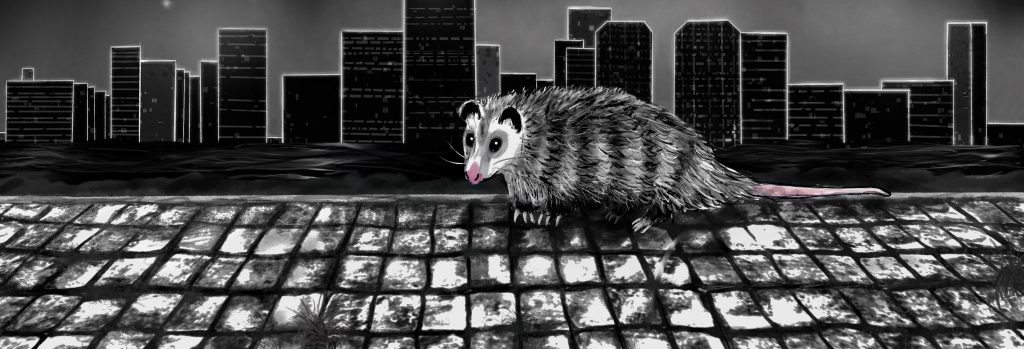
 Cobblestones RVA